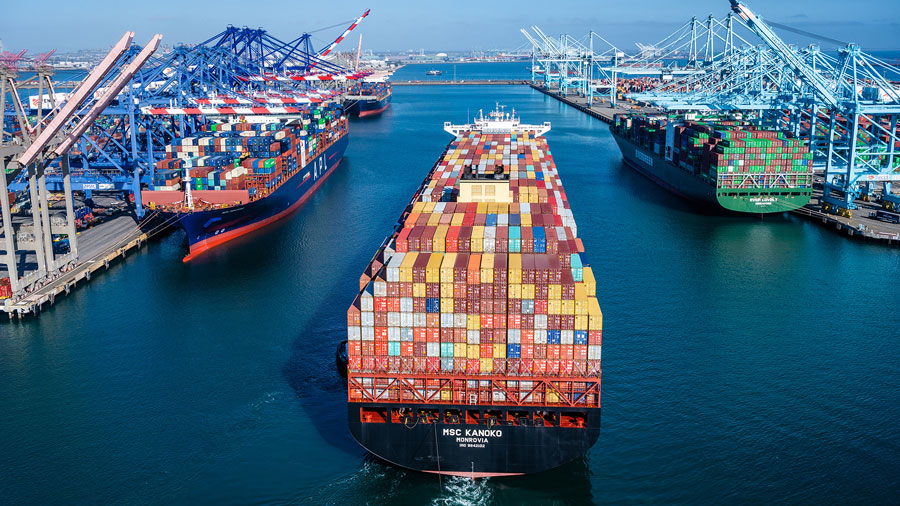
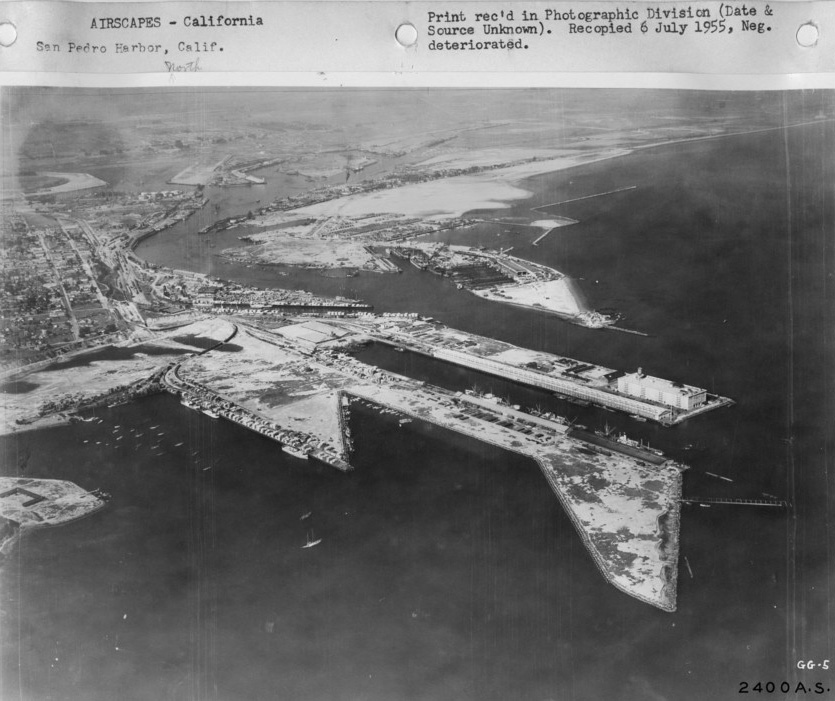
The community of San Pedro is on California’s southern coast within the city limits of Los Angeles but is located between Los Angeles Harbor and Long Beach Harbor. Terminal Island, an artificially constructed island, sits adjacent to the West of San Pedro. San Pedro covers an area of 11.4 square miles and Terminal Island, including all port facilities, encompasses 2.96 square miles. Geographically, the area is a desert basin surrounded by the San Gabriel Mountains. San Pedro is home to the Port of Los Angeles, the country’s leading port, and the port itself encompasses 7,500 acres of land and water along 43 miles of waterfront (Source).
Terminal Island is a manmade island split between the Port of Los Angeles and the Port of Long Beach. Land use on Terminal Island is primarily port and industrial activities, except for the Federal Correctional Institution, Terminal Island. Terminal Island was once a major commercial fishery hub with 16 canneries. Although the fishing industry has declined from its heyday, Terminal Island is still home to Fish Harbor, the port’s main commercial fishing district. The U.S. Census Bureau has not officially designated the communities affiliated with San Pedro and Terminal Island as “census-designated places.”
San Pedro occupies the ancestral homeland of the Kizh Nation, known post-colonization as the Gabrieleños because of their enslavement by the San Gabriel Mission. The Kizh Nation/Gabrieleño Band of Mission Indians is a sovereign tribe recognized by the State of California. At the onset of Euro-American contact, tribal populations in California are estimated to have been 300,000, the Gabrieleños are estimated to have been 5,000 before colonization. This number declined drastically as European diseases killed two-thirds of the Native American population during the colonial era.
San Pedro, which is located at the entrance to Los Angeles harbor, has been the heart of the Los Angeles port area since that time. The first known Euro-American activity at San Pedro harbor was trading between Spanish missionaries from Mission San Gabriel with Spanish colonial ships, as Spain prohibited trade with foreign powers in the late 18th century. Despite these restrictions, cargo smuggling played a significant role in San Pedro’s economic growth under colonial Spanish rule (Source). The town of Los Angeles (then named El Pueblo de la Reina de Los Angeles Sobre el Rio de la Porciuncula) was founded in 1781. In 1821, Mexico separated from Spain and laid claim to the region and the town of Los Angeles swore allegiance to the newly independent country. The U.S. invaded Los Angeles by sea at San Pedro in 1846 during the Mexican American War, however, was forced to surrender. Mexico eventually ceded the area to the United States in 1848 (Source).
The first wharf in San Pedro was built by Phineas Banning in 1851, a local entrepreneur who became known as “the father of Los Angeles Harbor.” San Pedro was eventually linked to Los Angeles by Southern California's first rail line, a twenty-mile track running between the two towns. When the rail began operation in 1869 it marked the beginning of the modern Port of Los Angeles, which is located at San Pedro (Source). Commerce began to boom and by 1885, 500,000 tons of cargo, primarily lumber and coal, moved through the Port of Los Angeles annually. In 1896, Congress appropriated $3.9 million to build an artificial harbor at San Pedro and in 1899 San Pedro was selected to be the new deep-water port for the city of Los Angeles (Source).
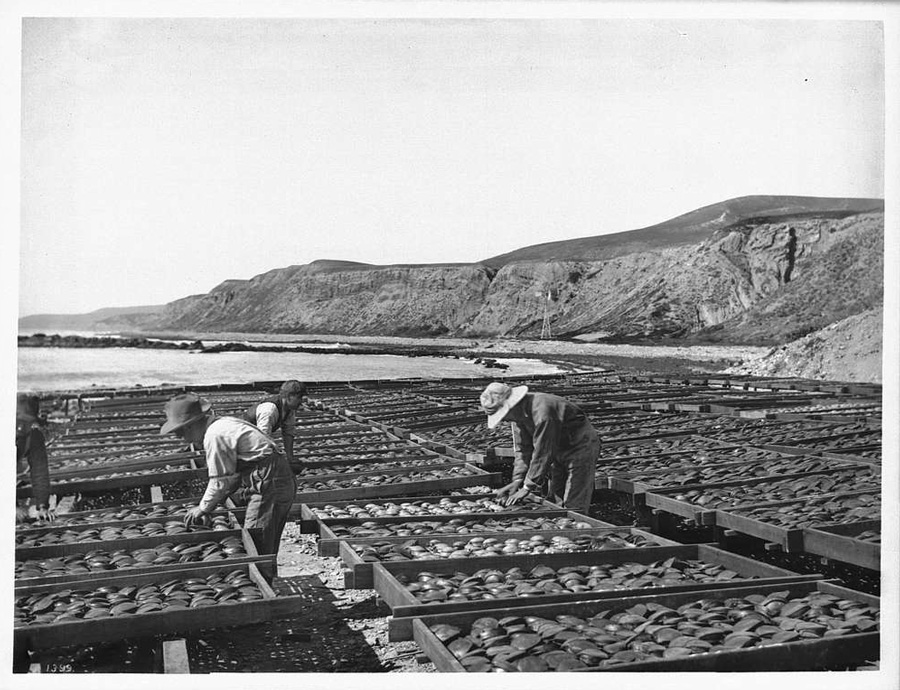
Southern California’s commercial fishing industry was started by the region’s diverse immigrant communities from China, Japan, Italy, and Portugal. Chinese settlers began diving for abalone on Southern California’s coast around 1850. Eventually Japanese divers developed dive technology that enabled them to transition the abalone industry to deeper water. These divers focused on White Point, northwest of San Pedro’s coast, and within several years set up a more permanent camp on Terminal Island. Terminal Island, originally a mudflat named “Isla Raza de Buena Gente” (Island of the Race of Good People). In 1911 the island was renamed ‘Terminal Island’ after the Los Angeles Terminal Railway built a line connecting the island to the city.
In the early 1900s, the California tuna industry began in San Pedro (Source). Most of the island’s canneries were established by 1918 along the Island’s wharf, what was colloquially known as Fish Harbor. By 1929 Terminal Island was home to a thriving fishing village of about 900 Japanese fishers who caught fish for local canneries, a population that soon grew to approximately 3,000 by the mid 20th century (Source). In addition to fishing and canneries, the main industries in San Pedro were oil drilling and shipbuilding (Source).
In 1909, San Pedro was officially annexed by the city of Los Angeles (Source). In 1912, a first fresh fish market was opened in San Pedro (Source). The fishing industry was a leading employer into the 1930s, and it was typical for entire families to work in the industry. In 1935, the industry is credited with employing thousands of people and having the largest single industry payroll (approximately $750,000 per month) in the city (Source). As noted in the Los Angeles Times, at one time the “Los Angeles harbor had 18 canneries and provided jobs for 17,000 people who processed the catches of 2,000 fishers who cruised up and down the California coast, and south to Mexico, South America and Central America from San Pedro, the Los Angeles’ port community.” (Source).

During World War II, an executive order brought about the forced removal of people of Japanese descent from what were termed ‘exclusion areas’ all over the United States. Due to its proximity to the San Pedro U.S. Naval Base, Terminal Island was designated an exclusion zone and the Terminal Island Japanese American community was relocated from their homes to concentration camps 226 miles north of Los Angeles. The fishing community and its history are remembered through the activities of the Terminal Islanders Club, a group of former residents and their descendants, and through public exhibits such as the Terminal Island Memorial Monument and Tāminaru, an exhibit at the Los Angeles Maritime Museum (Source).
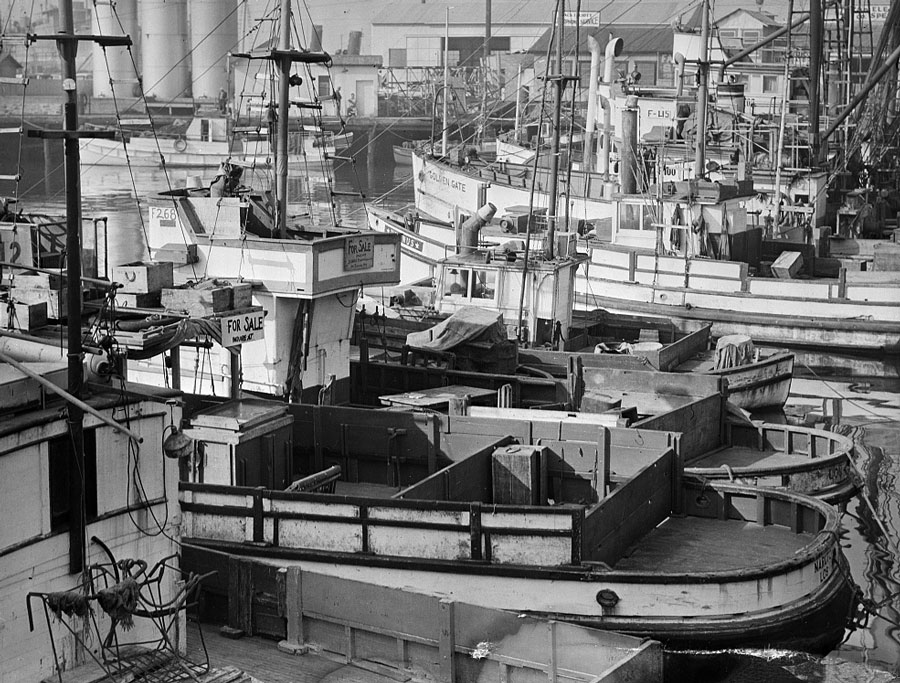
The 1920s also brought an influx of European immigrants from Italy, Portugal, Yugoslavia, and Scandinavian to San Pedro and the region’s fishing industry. Each group brought unique fishing technologies and San Pedro, and Southern California, in general, became home for a variety of gear types, including gill nets, purse seines, longline gear, and lampara gear. This versatility in gear type and method allowed San Pedro’s fishers to maintain diverse fishing portfolios during periods of fluctuation, enabling the port’s fishing industry to thrive. However, purse seiners, predominately operated by Yugoslavians and Italians, were consistently an important gear type for the port. San Pedro’s purse seine fleet is estimated to have been as many as 200 vessels during the 1930s to the 1950s.
After many years of a successful canning industry, the sardine fishery collapsed in the 1950s. As sardine, mackerel and tuna harvests diminished, San Pedro and Terminal Island’s fishing industry went into decline. By the 1970s and 80s most of Fish Harbor’s canneries had shut down, moving operations overseas (Source). With the collapse of sardines, the fishers and buyers who remained shifted their focus to other species such as market squid and red sea urchin. The market squid fishery became California’s largest commercial fishery by volume in 1993 and by 1996 it was the most valuable fishery in the state (Source).
In 1971, the red sea urchin fishery began in southern California as part of a National Marine Fisheries Service program to develop new fisheries. There was concern about sea urchins’ impact on kelp forests, and harvest was intended to help control the population. The fishery expanded rapidly as a lucrative export market to Japan, and by the late 1980s landings averaged 23.5 million pounds per year (Source). The early fishery was unregulated, and soon 75% of California’s sea urchin population was depleted. The industry initiated a moratorium in 1987 and regulations were put in place to reduce fishing effort and protect the stock. In 2000, the Japanese economic bubble burst negatively impacting the fishery, however, the processing sector developed a domestic sea urchin market which helped to buffer these impacts.
Shipping has been a core industry for the port since it opened. In 1963, the Vincent Thomas Bridge opened, replacing the passenger ferry service. This, coupled with infrastructure developments in trucks and trains, allowed the Port of Los Angeles to rise to worldwide prominence (Source). The Port of Los Angeles is ranked as the busiest port in the United States and is in the top 20 worldwide (Source).